Posts

Concentration of Gold Ores - a Key to Reducing Mercury Use in Artisanal and Small Scale Gold Mining

In artisanal gold mining, mercury is essentially used to concentrate the gold. It does this by bonding with the gold to form a heavy amalgam that is then easily separated from the other minerals. It follows therefore, that if mercury is used as a mechanism of concentration, producing concentrates of gold ores through other means can enable reduction or even elimination of mercury use. In other words, a good process of concentration can replace mercury and lead to big environmental and health improvements. Concentrating gold ores before applying mercury greatly reduces the mass of material that comes into contact with mercury. This reduces the amount of material that becomes contaminated and also the amount of mercury that is required to be applied. And of course, if concentration is done with sufficient sophistication and knowledge, mercury is not needed at all. As an important first step along the way to eliminating mercury, concentrating avoids a wor...

Is Borax the Miracle Chemical that Will Replace Mercury in Artisanal Gold Mining?

Image
The Myth of a Miracle Cure Can borax replace mercury in artisanal gold mining? – or is it better concentration that can replace mercury? Does Borax really have anything to do with it? Is Borax a Miracle Chemical? Those promoting borax as a replacement for mercury in small scale gold mining are overselling it and risk giving the impression that there is a miracle cure. They may be well intentioned but they are misleading the world by claiming that borax is a direct replacement for mercury. This is simply not true. The bar of gold shown here was entirely produced using borax. It was also entirely produced using mercury. How can that be if the word going around is that borax is a replacement for mercury? It is not. Borax is used in every Artisanal and Small Scale Mining gold shop in the world and has been for a hundred years. It has been used in pottery glazes for centuries for the same reason. It is a flux. Background: if a miner has 10 kilograms of sand that contai...

Health and Artisanal Gold Mining

Image
By Dr. Paleah Moher, Human and Ecosystem Health, AGC Artisanal and Small-scale Gold Mining (ASGM) presents a complex development and health-impact situation. On one hand it provides livelihoods to tens of millions people in the developing world while contributing significantly to the global supply of gold .  On the other hand ASGM is accompanied by serious environmental, social and health concerns. Here we discuss the health concerns and their solutions. Generally sustainable solutions support the ASGM sector’s economy while also addressing the associated health problems. This can be realized through inexpensive safer mining practices that come along with increasing degrees of education and formalisation. Fortunately there are often economic incentives to drive such improvements. Mercury is one of the main health concerns of ASGM. The use of mercury to amalgamate and extract metals from rock has been in practice for over 5000 years , mainly because it is a ...

Fifty thousand gold shops in the world's artisanal gold supply chain

Image
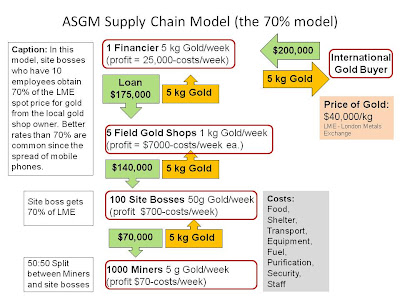
There are approximately 50,000 small gold shops serving artisanal and small scale gold miners worldwide. They are a doorway to engaging artisanal gold mining communities and they are the first link of many in the artisanal gold supply chain to consumers. by Kevin Telmer, Artisanal Gold Council Gold shops and the supply chain  Small informal gold shops are common in artisanal and small scale mining communities. After the miners, they are the next link downstream in the informal gold supply chain. They process raw gold or gold-mercury amalgam and then buy the raw gold product from miners at a price that is typically based on the London fix. This price is well known by both the miners and the shop owners due to mobile phones. Some shop owners will also refine the gold to close to 24 k purity (>99%) before selling it to the next level up in the supply chain. This is often done using the quartering technique which involves creating an alloy with silver and...

World Artisanal Gold Production

How much artisanal gold is produced per year is an interesting and important question. It defines the size of the artisanal and small scale gold mining (ASGM) economy. This is an informal economy that mainly serves the important role of supporting rural development in developing countries - just as it did in western North-America 100 years ago. Typically around 70% of the value of the gold remains with the miners and in-country. However, due to the informal nature of artisanal and small scale gold mining, a good estimate of annual gold production is not possible. The most recent robust estimate may be the one included in Telmer and Veiga (2009) World emissions of mercury from Artisanal and small scale gold mining. In N. Pirrone and R. Mason (eds.), Mercury Fate and Transport in the Global Atmosphere, Springer Science . This is available at Springer Link . The estimate is 330 tonnes of gold per year or 12% of official world production. The estimate considers a variety of...

Silver Causes Huge Increase in Mercury Use in Artisanal Gold Mining

Although gold is the primary target of most Artisanal and Small-scale Gold Miners (ASGM) that use mercury, the role of silver on mercury use can be astonishing. When mercury is applied to ores that contain both gold and native silver, in order to get all the gold, enough mercury must be used to amalgamate both the gold and the silver. Because silver is less rare than gold, some ores can contain ten times as much silver as gold or more - silver to gold ratios of 10:1 or 20:1. So more mercury must be added to these ores to capture all the gold. However, because silver forms a weaker amalgam than gold, the situation is even worse than these numbers imply. A typical mercury-gold amalgam formed by small scale miners contains roughly 50% mercury and 50% gold. Mercury-silver amalgam formed under similar conditions however is closer to 70% mercury and 30% silver. In the case of an ore that contains 10 times more silver than gold, about 20 times more mercury is added in order to capture the gol...

Price of mercury rising faster than gold

The price of mercury has has hit a new high of $1,850/flask (76lbs) or $53.67/kg and the  gold:mercury  price ratio has dropped to 840 - see  www.mercurywatch.org Some part of the mercury price increase is likely due to increased demand from Artisanal and Small Scale Gold Mining (ASGM), which is booming, along with the price in gold, and is now the world's largest demand for mercury. The forthcoming export bans by the EU (2011) and the US (2013), representing a future supply squeeze, may also be contributing to the price rise. The increase in the mercury price over the last year (almost tripling from $650/flask to $1,850/flask) has actually outpaced the rise in gold prices making the relative cost of using mercury to extract gold higher. The  gold:mercury  price ratio is an indicator of the relative cost of using mercury to extract gold. Overall, the price increase makes mercury more expensive for uses, legal or illegal, and will, to some degree, be ...